Cloud Drama
China Crossing VI
China Crossing VI was a fabulous week of cultural exchange, creativity and music, hosted by The Confucius Institute at Victoria University of Wellington in collaboration with New Zealand School of Music—Te Kōkī, Victoria University of Wellington.
China Crossing VI began with inspiring masterclasses and composition workshops led by Chinese-based composer Gao Ping for NZSM students, culminating in two concerts celebrating contemporary and traditional music from both China and New Zealand, and the live concert world premiere of Gao Ping's Cloud Drama.
Huge thanks to the outstanding musicians who brought this unique programme to life: Gao Ping (composer and piano), Lan Weiwei (pipa), Martin Riseley (violin), Natalia Mann (harp), Gabriela Glapska (piano), and Hsuan-Chen Lin (ruan). It was such a privilege to work with everyone.
Thank you also to Confucius Institute Arts Advisor Luo Hui for curating such a rich and engaging programme.
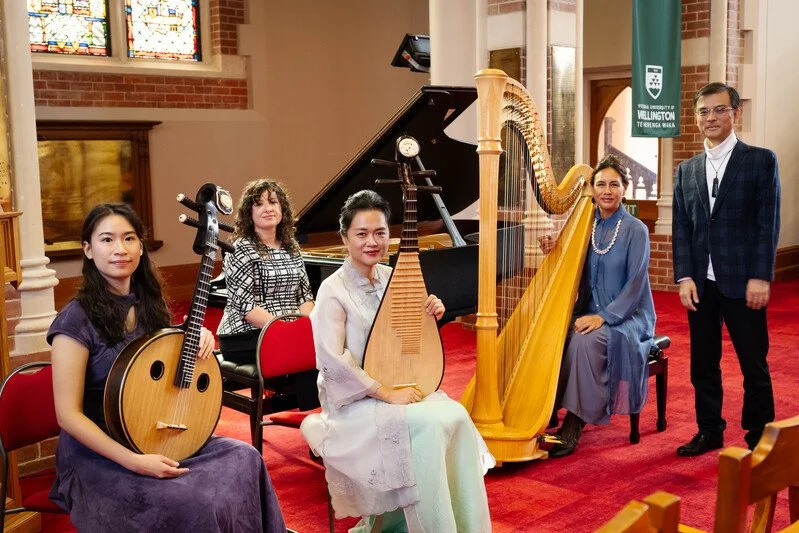
L-R Hsuen-Chen Lin, Gabriela Glapska, Lan Weiwei, Natalia Mann, Gao Ping
Chanting in the Boat.
This was a wonderful week at Victoria University, my old stomping ground.
I was tasked with performing Chanting in the Boat by composer Gao Ping, a trio for harp, pipa and ruan. The ensemble included Lan Weiwei, who flew in from Beijing, acclaimed as one of the best pipa players in China, and the lovely ruan player Hsuan-Chen Lin from Taiwan, who is studying for her PhD in Wellington.
It was a first for me to play within that soundfield. "The harp is the water," said composer Gao Ping as he listened to our trio rehearsal. “The piece is really like being in a boat.” The detail within Gao Ping's compositional style is particular, and it did take some practice for me to master the timings and inflections. It's a very spacious, poetic, almost hypnotic piece, led mostly by the harp, with textured fluttering and subtle floating melodies by the pipa and ruan.
After a week of intense rehearsals by the various performers, we arrived at our first lunchtime concert, which opened with a thoughtful and eloquent introduction by Luo Hui, the curator of the project.
The last time I played one of Gao Ping’s works was about twelve years ago - Shuo Shu Ren- The Storyteller- with the Stroma Contemporary Music Ensemble in Wellington, in the same room, the Hunter Council Chamber. I was somewhat relieved when he told me all these years later that The Storyteller was considered a very difficult harp part, because I recalled needing to be very focused on it. We remembered spending time with Jack Body, responsible for building up the ethnomusicology department of the NZ School of Music, who was very welcoming to us, and we’d had fun chatting after the concert. He has since passed away. It was nice this time to re-meet elders such as Judith Exley, Robert Oliver and others who are great supporters of Gao Ping's art.
My sister Fiona Mann works for the Confucius Institute, which hosted the China Crossing VI cultural exchange. Fiona speaks Chinese, having studied at two universities in China, practised Chinese calligraphy and is passionate about Chinese teas from the various regions. She put the idea forward to Luo Hui that I could be a guest in this year’s China Crossing VI, because she felt that I had something different to offer to the cultural exchange.
We have Chinese heritage through our great-grandfather, although as a family we have never known much about it. I usually identify as Samoan-European. I became interested in my Chinese side in the last decade while developing my practice, Resonance music. Experimenting with playing the resonance fields of trees and plants, I found pentatonic scales and a sense of Chinese grace in melody and modes. Considering that the interpretation could be attributed to my own DNA ‘filter’ as the resonance artist, I began to look into what it means to be Chinese. Being situated in a Western culture, I turned to Google for ideas. The first thing I found was that the main characteristic of Chinese art is the reflection of nature. Luo Hui echoed that sentiment for me this week: that the main aim of Chinese art is to have a conversation with nature.
The original solo that I chose to play, The Small Ferns, was written about the hills around Wellington. It’s a beautiful, light-hearted filigree piece that I’ve been working on recently, and I thought to give it its first personal airing while at home. Others have played this piece before, but not me, because, well, I found it a little challenging to re-learn! Much easier to improvise. :)
On the morning of the second concert, the weather had cleared, and I was able to go for a walk along those old favourite pathways that I had written the piece about. In my memory, as in the piece, small delicate ferns burst with life along pathways of lovely Aotearoa bush forest. As I approached, I saw new signs on the fence warning that there may be hunters in the area and to be alert for gunshots. That was different. I slowed a little, then pushed on.
In the old days, I used to treasure the moment when the pavement ended, my foot stepped off the concrete onto the dark brown earth, and my head became enclosed above by green leaves. The air would go sweet, and the damp green sound of birds and bugs made a lovely peace.
This time, I felt a strange absence. There wasn’t that feeling of relief, of throwing the world behind me. This time… what was different? I stopped and listened - silence. I looked around - stillness, mud. A single Tui bird in a tree found her food and flew off without a single chirp. There was nothing. No call and response. No fluttering or bustling. As if everything was holding its breath, hiding, staying still. The animals must have gone silent in defence, in wariness, in fear of… the sound of the human footstep… because now that sound could well mean a gunshot.
I soon learned that feral animals such as deer, wild pigs, and even wallabies are rife in Aotearoa landscapes. The ecosystems are way out of balance. With my learned Indigenous Australian lens, I can now see that the mountains have been untended since the wildfires and felling of trees many years ago, and the landscape is in a terribly dire state. It will take awareness and dedication to return the landscape to health, but it is very doable, and I hope that we can turn that around soon.
Coming back to the second Cloud Drama concert later that afternoon, I felt that I wanted to bring the morning experience into my performance. I began the piece this time with dramatic gunshots on the harp sound box, and low chords evoking the eerie feeling I’d had in the morning. I played into the upset of the forest creatures and the wish to repopulate the forest with its rightful, healthy ecosystem. Gradually I brought back the memory of the small ferns bursting with life, in the hope that this expression in performance may emit that signal into the universe, and just perhaps help it along.
The Small Ferns came after a stunning traditional pipa solo by Lan Weiwei in which the music spoke of the Wild Geese. I felt I could hear them fly through the air and come to rest on a favourite sandbank in a lake, where she played their many cries. Thirdly, we played Chanting in the Boat, which concluded the first half of the concert.
In the second half, it was incredible to hear Gao Ping play his piano works, especially Porridge, a spoken-word composition, which I think everyone fell in love with for its combination of delicious food and fantabulous pianism, as performed by a true artist. His featured piece, Cloud Drama, performed by Lan Weiwei and pianist Gabriela Glapska, was equal parts breathtaking and fearsome. We finished the concert with a trio improvisation of Gao Ping, Lan Weiwei and myself, which was sparkling and delightful, and the audience enjoyed it very much.
There was a wonderful Wellington crowd at the University chamber that day, including the Chinese community, little kids and supportive elders, music students, composers, ethnomusicologists, family and some of my wonderful old friends. My son Phoenix (11) brought me a canape. ‘You have to try this!’ He went on to say that the gunshots at the beginning of my piece were a bit dramatic, but it was a good performance otherwise, and that he really enjoyed the whole concert.
Thanks once again to the Confucius Institute and my fellow artists for having me on this wonderful and unforgettable project.
Sheet music for The Small Ferns can be found on the NZ Harp Society website link here.